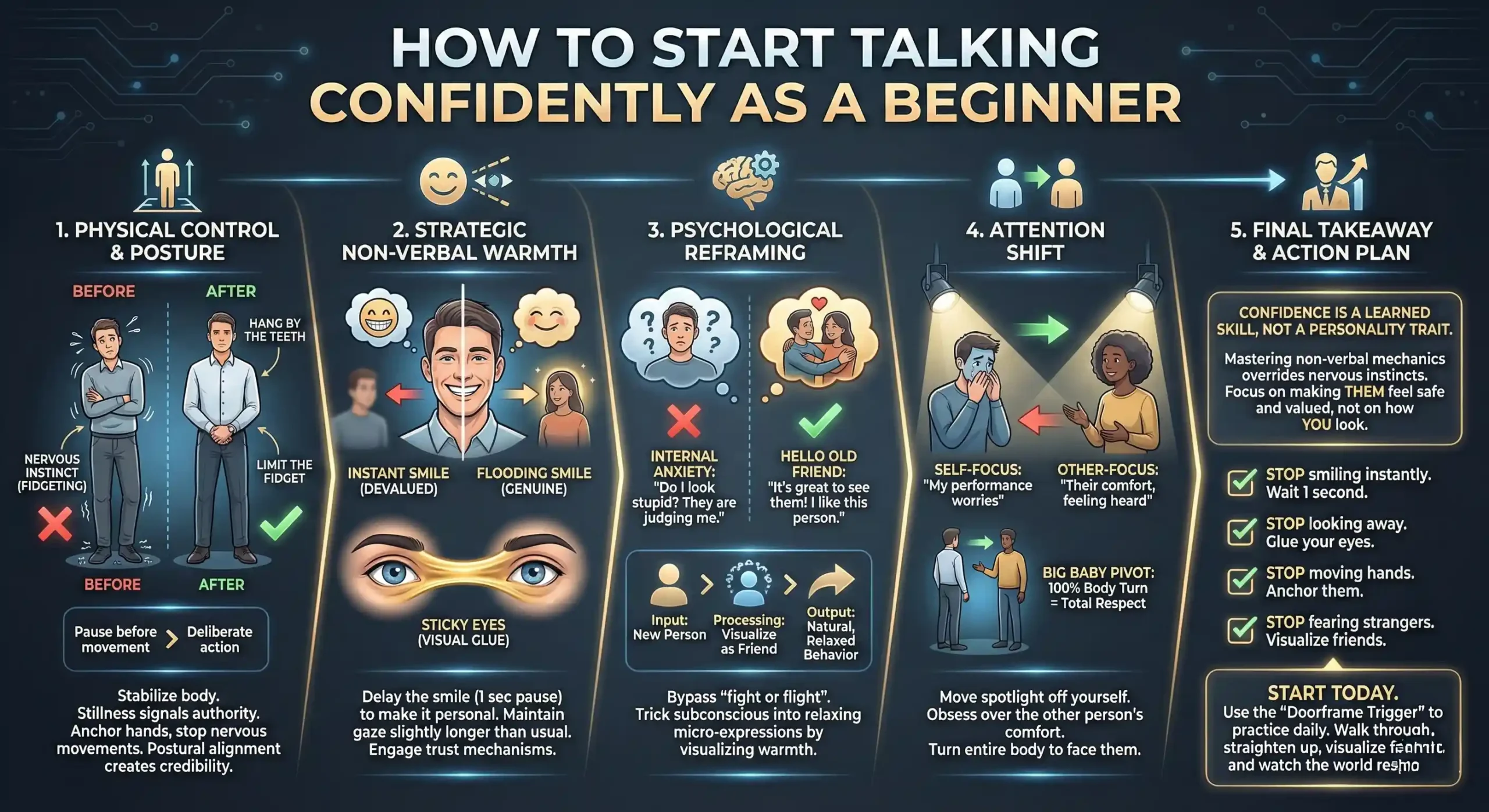
Learning how to start talking confidently as a beginner is not about changing your personality or memorizing a dictionary of clever remarks. It is about mastering the mechanics of non-verbal signals and shifting your mental focus from internal anxiety to external observation.
Research and expert analysis confirm that confidence is a learned skill, largely physical in nature. It is less about what you say and almost entirely about how you present yourself before and during the conversation. The transition from a nervous beginner to a confident speaker requires the adoption of specific “micro-skills”—small, manageable physical actions that trigger positive psychological feedback loops in both you and your listener.
To start talking confidently, you must operationalize the following core principles:
- Physical Control precedes Verbal Fluency: You must stabilize your body language to signal credibility. This involves techniques like Limiting the Fidget and maintaining Postural Alignment (Hanging by the Teeth)
- Strategic Non-Verbal Warmth: You must engage the other person’s trust mechanism immediately. The Flooding Smile (delaying your smile for a split second) and Sticky Eyes (maintaining gaze slightly longer than usual) are primary tools for this.
- Psychological Reframing: You must bypass the “fight or flight” response that causes awkwardness. The Hello Old Friend technique (visualizing the stranger as a dear friend) tricks your subconscious into relaxing your micro-expressions.
- Attention Shift: You must move the spotlight off yourself. Nervous beginners obsess over their own performance .
This report provides an exhaustive, step-by-step technical guide to these mechanisms. It strips away vague advice like “just be yourself” and replaces it with concrete, actionable instructions derived from the principles of Leil Lowndes and modern social psychology.
| Confidence Component | Beginner Struggle | Expert Technique | Result |
| Facial Expression | Instant, generic smiling at everyone. | The Flooding Smile: Pause 1 second, then smile. | appears genuine and personal. |
| Eye Contact | Darting eyes, looking down, looking away. | Sticky Eyes: visually “gluing” to the partner. | Signals intense interest and confidence. |
| Body Language | Fidgeting, touching face, checking phone. | Limit the Fidget: Anchoring hands, stillness. | Signals high status and credibility. |
| Attention | Turning neck only, distracted by room. | Big Baby Pivot: Turning 100% of body to partner. | Signals total respect and warmth. |
| Mental State | “They are judging me.” | Hello Old Friend: “I like this person.” | Triggers natural, relaxed behavior. |
What This Topic Means in Simple Words
When we discuss “talking confidently,” we are often referring to two distinct things: internal assurance (how you feel) and external projection (how you appear). For a beginner, the external projection is the priority. You can look confident even if you feel terrified.
In simple terms, “talking confidently” means managing the signals your body sends to others so that they feel safe, valued, and interested.
The Mechanics of Social Confidence
Communication is a feedback loop.
- The Input: You send a signal (e.g., a smile, eye contact, a question).
- The Processing: The other person’s brain interprets that signal (e.g., “This person is friendly,” or “This person is hiding something”).
- The Output: They react based on that interpretation (e.g., they smile back, or they step away).
If you are nervous, you might unintentionally send signals of “threat” or “disinterest.”
- Example: You are shy, so you don’t look them in the eye.
- Their Interpretation: “He is bored,” or “He is untrustworthy.”
- Their Reaction: They stop talking to you.
- Your Conclusion: “I am bad at talking.”
This creates a negative spiral. Learning to talk confidently means breaking this spiral by manually overriding your nervous instincts. Instead of looking down (instinct), you use Sticky Eyes (technique). Instead of fidgeting (instinct), you use Limit the Fidget (technique).
It is Not About “Extroversion”
Many beginners confuse confidence with high energy or loud talking (extroversion). This is a mistake.
- Extroversion is a personality type that gains energy from social interaction.
- Confidence is the ability to interact without fear or hesitation.
You can be a quiet, low-energy introvert and still be a deeply confident speaker. In fact, many of the techniques in this report, such as listening aggressively or observing behavior, favor introverts.
Why This Problem / Topic Matters
The inability to speak confidently is not just a minor social inconvenience; it is a systemic barrier to advancement in almost every domain of modern life. Human beings are social animals who rely on rapid, subconscious assessments of one another to determine hierarchy, trustworthiness, and value.
The Professional Cost (The “Competence-Confidence Gap”)
In the workplace, competence alone is rarely enough. Research suggests that people who sound confident are often perceived as more competent than those who are actually more skilled but appear unsure.
- The “Invisible” Employee: A beginner who cannot speak up in meetings or network effectively is often overlooked for promotions.
- Client Trust: In sales or consulting, a “smooth introduction” and a firm handshake are not just niceties; they are the first data points a client uses to judge your capability. A nervous introduction can “break” a client relationship before it begins.
- Credibility: Fidgeting or touching your face while speaking is evolutionarily linked to deception. If you cannot control these “tells,” colleagues may subconsciously distrust your data or your promises.
The Social and Emotional Toll
- Isolation Cycle: Fear of conversation leads to avoidance. Avoidance leads to a lack of practice. Lack of practice leads to skill atrophy. This cycle can result in profound loneliness and social anxiety.
- Misinterpretation of Character: Shy people are often mislabeled as “arrogant,” “cold,” or “stuck up” because their defense mechanisms (crossed arms, lack of smiles) mimic the signals of unfriendliness. Learning these techniques allows you to align your intentions with your impact.
The Opportunity for Mastery
Mastering these skills changes the difficulty setting of life from “Hard” to “Normal.”
- Safety: Knowing you have a toolkit (like “Hello Old Friend”) reduces the terror of the unknown. You stop worrying about surviving the interaction and start focusing on connecting.
- Influence: The ability to hold eye contact (Sticky Eyes) or make someone feel like the center of the universe (Big Baby Pivot) gives you influence. People naturally want to be around those who make them feel good.
Key Ideas from “How to Talk to Anyone” (Simplified)
The most practical framework for beginners comes from Leil Lowndes, who codified specific social behaviors into “92 Little Tricks.” For a beginner learning how to start talking confidently, we will focus on the foundational physical techniques that yield the highest return on investment.
Technique 1: The Flooding Smile
The Problem: Most beginners have a “quick trigger” smile. They smile instantly at anyone who comes near them. This effectively devalues the smile. It signals, “I smile at everyone because I am nervous or compliant,” rather than “I am smiling because I am happy to see you.”
The Solution:
- Pause: When you greet someone, pause. Look at their face. Look at their eyes.
- Soak: Let your brain register their presence.
- Flood: Only then let a warm, large smile spread across your face. Let it reach your eyes.
Why It Works:
This delay (less than a second) convinces the recipient that the smile is a specific reaction to them. It feels personal, genuine. It makes the recipient feel that they have “earned” your smile, which increases your value in their eyes.
Technique 2: Sticky Eyes
The Problem: Eye contact is intense. Beginners often break it quickly to relieve tension, looking at the floor or the wall. This signals submission or a lack of interest.
The Solution:
- Glue: Visualize that your eyes are stuck to your conversation partner with warm, sticky taffy.
- Hold: Do not break eye contact even when they finish speaking. Keep looking for a moment longer.
- Stretch: When you must look away (to eat, drink, or check for hazards), do not dart your eyes. Peel them away slowly, as if stretching the taffy until it snaps.
Why It Works:
It signals “I am captivated.” It makes the speaker feel intelligent and fascinating. It is a dominance signal, but a “warm” one. Warning: This must be accompanied by a friendly expression, or it becomes a “predatory stare”.1
Technique 3: Limit the Fidget
The Problem: Anxiety leaks out through the extremities. Beginners touch their face, scratch their nose, fix their collar, or tap their feet. These are “displacement activities” used to self-soothe.
The Solution:
- Scan: Whenever the conversation matters, perform a mental scan.
- Lock: Keep your hands away from your face. Anchor them on your lap, at your sides, or on the table.
- Ignore: If your nose itches, ignore it. If your ear tingles, ignore it.
Why It Works:
Stillness signals authority. High-status individuals (leaders, experts) rarely fidget. By artificially suppressing the fidget, you “hack” your appearance to look like a high-status individual. Listeners subconsciously trust a still speaker more than a moving one.
Technique 4: The Big-Baby Pivot
The Problem: When introduced to someone new, beginners often keep their body planted and just turn their head. This “half-turn” signals that the new person is not important enough to warrant moving.
The Solution:
- Trigger: When someone is introduced to you.
- Pivot: Turn your entire body—eyes, chest, knees, and toes—to face them directly.
- Visual: Give them the undivided attention you would give a baby who just crawled up to you.
Why It Works:
The “heart-to-heart” alignment creates a sensation of total acceptance. It shouts, “I think you are very special.” It creates a vacuum of attention that pulls the other person in.
Technique 5: Hello Old Friend
The Problem: The “Stranger Danger” reflex. When we meet new people, our bodies naturally tense up, our eyebrows lower, and our guard goes up. This makes us look cold or intimidated.
The Solution:
- Visualize: When you walk into a room or meet a stranger, play a mental trick. Tell yourself, “That’s my old friend [Name]! I haven’t seen them in years!”
- React: Allow your body to react to that thought. Your eyebrows will soften, your pupils will dilate, and your smile will be genuine.
- Engage: Speak to them with the warmth and familiarity you would use with that old friend.
Why It Works:
You cannot consciously control every micro-muscle in your face. But your subconscious can. By changing the input (“This is a friend”), you automatically change the output (warm, open signals). This usually triggers a reciprocal “friend” reaction from them.
Technique 6: Epoxy Eyes (Advanced)
The Problem: In a group, beginners often look at whoever is talking. This is polite, but it doesn’t build a connection with a specific target.
The Solution:
- Target: Choose the person you want to connect with.
- Focus: Watch them even when someone else is talking. Watch their reaction to the speaker.
- Signal: This signals, “I am more interested in your thoughts than in the speaker’s words.”
Why It Works:
It is an intense signal of attraction or professional deference. It says, “I only have eyes for you.” Note: Use with caution; it is very powerful.
How This Helps in Real Life
These techniques are not just for parties. They apply to every human interaction.
Scenario A: The Networking Event
The Struggle: You are standing with a drink, feeling awkward. You meet a potential employer.
The Application:
- Hello Old Friend: You approach them thinking, “It’s great to see Dave again!” This relaxes your shoulders.
- Flooding Smile: You shake their hand, pause, and then smile warmly. They feel you are genuinely happy to meet them, not just networking.
- Limit the Fidget: As you explain your job, you stand perfectly still. You do not touch your tie or hair. You look confident and credible.
- Result: You are remembered as “that impressive, calm person” rather than “that nervous job seeker”.
Scenario B: The Date
The Struggle: You are worried about awkward silences.
The Application:
- Sticky Eyes: You hold their gaze deeply. This builds romantic tension and intimacy.
- Big Baby Pivot: You turn your whole body toward them in the booth. They feel like the center of your world.
- Listening: When they talk, you don’t interrupt. You use the silence to look at them.
- Result: The “awkward silence” becomes a “moment of connection”.
Scenario C: The Service Interaction
The Struggle: You feel invisible or rushed.
The Application:
- Flooding Smile: You look the barista in the eye, pause, and smile.
- Hello Old Friend: You treat them like a peer, not a servant.
- Result: You likely get better service, but more importantly, you get a “rep” of positive social feedback that boosts your confidence for the next interaction.
Who This Is Helpful For
1. Introverts
Introverts often feel they need to “act extroverted” (talk a lot, be loud) to be confident. This is false.
- The Advantage: Introverts are natural observers. Techniques like Sticky Eyes and Horse Sense (observing others’ reactions) play to an introvert’s strengths.
- The Strategy: Use your listening skills. Let the other person talk, but use your eyes and body to be an “active” participant. You can control the conversation by listening.
2. The Socially Anxious
Social anxiety creates a focus on the self (“My hands are shaking,” “My face is red”).
- The Advantage: These techniques provide an external focus. If you are busy counting the other person’s blinks (to maintain eye contact) or visualizing them as an old friend, you have less mental bandwidth to obsess over your own anxiety.
- The Strategy: Treat these techniques as a “job.” Your job is to pivot. Your job is to pause your smile. The structure reduces the chaos of the interaction.
3. Non-Native Speakers
Beginners who are learning a language often lack confidence because they fear making grammar mistakes.
- The Advantage: 80% of communication is non-verbal.
- The Strategy: A Flooding Smile and Sticky Eyes communicate “I am friendly and interested” in every language. If your body language is confident, people will be patient with your vocabulary.
Common Mistakes People Make
Learning these techniques is like learning to drive; it is easy to overcorrect and crash.
Mistake 1: The “Plastic” Salesman Smile
- What it is: Smiling instantly and holding it too long.
- Why it fails: It looks like a mask. It signals that you want something (money, approval).
- Correction: Always use the Flooding Smile. The pause is critical. It validates the smile.
Mistake 2: The “Serial Killer” Stare
- What it is: Using Sticky Eyes without warmth. Staring without blinking.
- Why it fails: Eye contact triggers the amygdala (threat detection). If you stare intensely with a blank face, you look predatory.
- Correction: You must have “soft” eyes. You must blink. If the other person looks uncomfortable, look away slowly. Men: Be very careful using this on other men, as it is a challenge signal.
Mistake 3: The Nervous “Phone Crutch”
- What it is: Pulling out your phone the moment there is a lull in conversation or when you are alone in a crowd.
- Why it fails: It is a giant “Do Not Disturb” sign. It closes your body language and disconnects you from the room.
- Correction: Leave the phone in your pocket. Be bored. Look around. Use Hello Old Friend on the room. Open body language invites approach.
Mistake 4: The “Naked Thank You”
- What it is: Saying “Thank you” and nothing else.
- Why it fails: It is a throwaway phrase.
- Correction: Always attach a “because.” “Thank you for waiting.” “Thank you for asking.” This signals social intelligence.
Mistake 5: Over-Nodding
- What it is: Nodding your head furiously like a bobblehead while listening.
- Why it fails: It signals “Please like me! I agree with everything!” It is a low-status behavior.
- Correction: Nod slowly. Nod only when you actually agree or want them to continue. Stillness is better than frantic movement.
How to Apply This Safely & Naturally
Do not try to use all 92 tricks at once. You will look robotic. Use this graduated training plan.
Phase 1: The Mirror Lab (Home)
Practice where no one can see you.
- The Smile Drill: Stand in front of a mirror. Relax your face. Look at your eyes. Count “1”. Smile slowly. Check: Does it look real? Practice until you can control the speed of your smile.
- The Fidget Check: Talk to yourself for 60 seconds about your day. Watch your hands. Do you touch your face? Do you sway? Identify your “tells”.
Phase 2: The “Low-Stakes” Arena (Service)
Practice on people who are paid to be nice to you. Cashiers, waiters, librarians.
- Mission: Use Hello Old Friend on a cashier. See if their demeanor changes.
- Mission: Use Sticky Eyes while a waiter takes your order. Do not look at the menu. Look at them.
- Mission: Use the Flooding Smile on a bus driver.
Phase 3: The “Doorframe” Trigger (Daily Life)
Build a habit loop.
- Trigger: Every time you walk through a doorframe (office, home, gym).
- Action:
- Hang by your teeth: Straighten your spine.
- Relax face: Prepare for a smile.
- Hello Old Friend: Visualize the people inside are friends.
- Reward: You enter every room looking confident.
Phase 4: High-Stakes Application (Work/Social)
Once the habits are automatic, use them in meetings and dates.
- Goal: Focus entirely on Limit the Fidget during a presentation.
- Goal: Use Big Baby Pivot when your boss enters the room.
Related Questions People Ask
“What if my mind goes blank?”
The Cause: Fear of judgment locks up the brain.
The Fix:
- Don’t Panic: Silence is only awkward if you look panicked.
- Admit It: “I just completely lost my train of thought!” Say it with a smile. It shows confidence.
- Pivot: Ask a question about them or the environment. “Anyway, how do you know the host?”.
“Is this manipulation?”
The Concern: Is it “fake” to delay a smile or visualize a friend?
The Truth: All social skills are “manipulation” in the sense that you are managing the impression you make. The difference is intent.
- Malicious Manipulation: Using skills to deceive or harm.
- Social Intelligence: Using skills to make others feel comfortable, heard, and valued.
- Ethical Check: Are you doing this to connect? Then it is not manipulation; it is kindness. You are putting effort into making the interaction pleasant.
“How do I start a conversation without being weird?”
The Fear: Saying the wrong thing.
The Fix:
- Observation: Comment on something you both can see (the weather, the food, the line). “This line is moving forever.”
- Curiosity: Ask an open question. “Have you tried the coffee here?”
- Compliment: “I really like that jacket.” (Be specific).
- Avoid: “How are you?” (It’s too generic). Try “How is your morning going?” instead.
“I’m boring. What do I talk about?”
The Reality: You don’t need to be interesting; you need to be interested.
The Fix: People love talking about themselves. If you use Sticky Eyes and ask questions (“How did you get into that field?”, “What was that like?”), they will think you are the most fascinating conversationalist in the room, even if you said very little.
What to Remember
Learning how to start talking confidently as a beginner is a journey of “externalizing” your focus.
The beginner thinks: “How do I look? Am I smiling enough? Do they like me?”
The confident speaker thinks: “How do they feel? Are they comfortable? I will make them feel seen.”
By using the technical tools from this report—The Flooding Smile, Sticky Eyes, Limit the Fidget, and Hello Old Friend—you force your brain to make this shift. You stop being a victim of your own anxiety and become an architect of the social interaction.
Summary of Action Plan:
- Stop smiling instantly. Wait 1 second.
- Stop looking away. Glue your eyes to them.
- Stop moving your hands. Anchor them.
- Stop fearing strangers. Visualize them as old friends.
Start today. Walk through the next doorframe, straighten your back, imagine a room full of friends, and watch how the world changes its response to you.
Need Any self-help books visit our website - www.boirath.com




2 thoughts on “How to Start Talking Confidently as a Beginner”