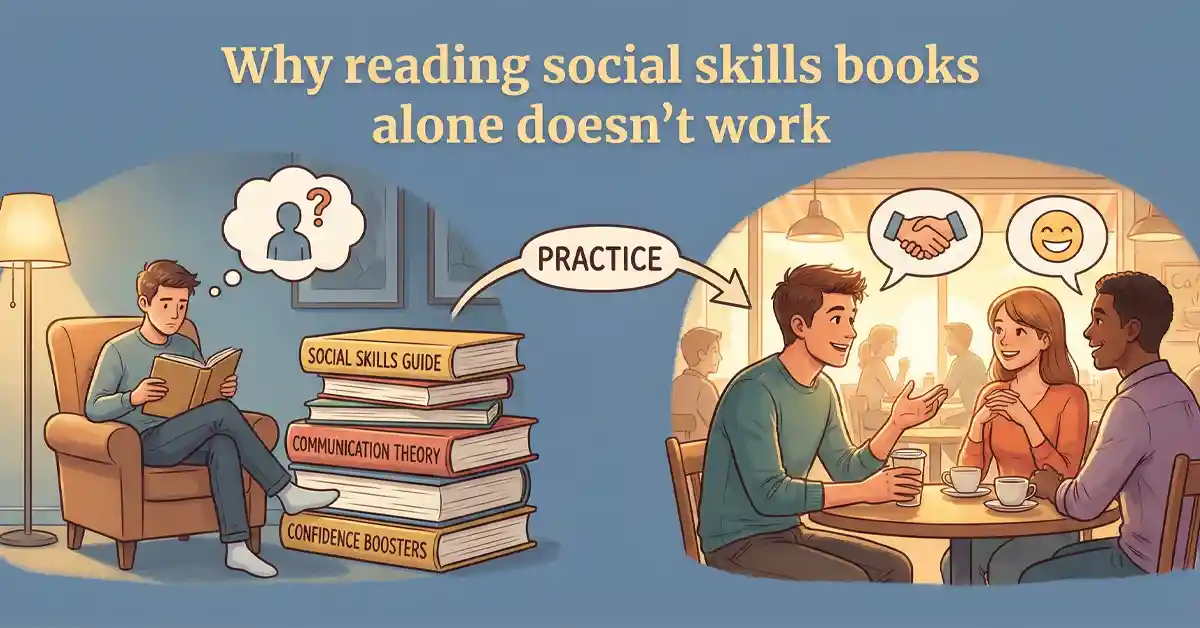
Reading a good social skills book can feel like progress. You finish a chapter, recognize yourself in the examples, and imagine the next conversation going differently. Then the conversation happens, and nothing changes. That gap is not a personal failing. It reflects the difference between knowing about a skill and being able to perform it when timing, tone, and nerves are involved.
Social skill is largely procedural: it is stored and expressed through performance and improves through repeated practice. Books supply frameworks and scripts, which is real value, but they cannot supply the live feedback and repetition that turn those ideas into automatic behavior.
What This Topic Means in Simple Words
Many people assume that understanding a concept intellectually means they have mastered it. That assumption is the root of most frustration with self-improvement reading.
Think of learning social skills like learning to ride a bicycle. You can read every manual on balance and pedaling, and understand exactly how the gears work. The first time you sit on a real bike, you may still wobble or fall.
Reading gives you the theory. It puts information in your head. Social skills, though, involve your body, your voice, and your emotions. Trusting a book alone skips the stage where your brain learns to stay calm and respond in real time, and a book cannot do that training for you.
Research describes skill acquisition as a staged process moving from a cognitive stage, where performance is slow, effortful, and heavily dependent on instructions held in mind, toward an autonomous stage. Declarative knowledge is built through reading and instruction, while procedural knowledge is built through practice, repetition, and hands-on experience. That is the precise gap a book cannot close on its own.
Why Reading Social Skills Books Alone Doesn’t Work Without Practice
This issue causes a lot of frustration for people trying to improve themselves. You might finish a highly rated book and feel a rush of excitement. You feel prepared. But when you walk into a party or a meeting the next day, you may freeze up just like before.
That gap often leads to negative self-talk: “I read the book, so why am I still awkward? There must be something wrong with me.”
There is nothing wrong with you. The problem is the method. Reading is a passive, comfortable activity. Interacting with people is active, unpredictable, and often uncomfortable. When you rely only on reading, you get a false sense of progress. You feel like you are doing the work, but you are actually avoiding the scary part: the practice.
Evidence from clinical research supports the principle that repeated exposure reduces anxiety more effectively than cognitive learning alone. In a cluster-randomised microtrial of 191 children aged 8 to 13 with elevated social anxiety symptoms, exposure produced more favorable effects than cognitive restructuring, and combining the two did not yield greater benefit than either component alone. Exposure also had a positive effect on social anxiety, distress, avoidant behavior, and social skills in that group. Because the study involved children in a prevention context, treat it as support for the principle of gradual, repeated practice rather than a proven adult protocol.
Group therapy research further demonstrates why interactive practice works better than solitary study. Communication group therapy provides a live rehearsal space for social skills where mistakes are low-stakes and feedback is immediate. Unlike individual counseling, group therapy replicates the texture of real social life: multiple voices, competing perspectives, and the mild unpredictability of other people. Decades of research on group cohesion suggest peer feedback and observational learning produce social skill gains that solitary practice, or even individual coaching, simply cannot replicate.
Key Ideas from “How to Talk to Anyone” (Simplified)
The book How to Talk to Anyone by Leil Lowndes offers many specific techniques to improve communication. Knowing the names of these techniques is not enough. What matters is understanding the simple principles behind them so you can practice them in real situations. The following concepts are illustrative examples from the book, not independently verified techniques.
1. The Delayed Smile
Most people smile instantly when they see someone, which can look automatic or insincere. The book suggests waiting just a second before smiling. Look at the person’s face, pause, and then let a warm smile spread. The pause makes the smile feel specific to that person rather than a reflex.
2. Steady Eye Contact
When you are listening to someone, you usually look at them. When you stop talking or look away, it can break the connection. The idea here is to keep your eyes on the person slightly after they finish speaking, which signals genuine interest.
3. Turning Your Whole Body
When someone new approaches you, do not just turn your head. Turn your entire body toward them. This physical pivot sends a clear signal that they have your full attention and makes the other person feel welcomed without you saying a word.
4. The “Old Friend” Mindset
Anxiety often comes from treating strangers like strangers. The advice is to imagine the person you are meeting is an old friend you haven’t seen in a while. This can change your body language: your eyebrows relax, your posture opens up, and you speak more naturally.
Note that cultural norms for nonverbal cues such as eye contact, smiling, and body orientation vary significantly. What reads as friendly in one culture may read as aggressive or disrespectful in another. Adapt these principles to your context.
A Practical Low-Stakes Practice Plan
To actually improve, you must bridge the gap between the page and the real world. You need a plan to apply what you have learned safely and naturally. The following method is a reasonable application of practice principles, not a validated protocol.
Start with low-stakes practice. Do not practice new skills first on your boss or a date. Practice on people you will likely not see again, such as a cashier, a barista, or a bus driver.
- Try the delayed smile when buying coffee.
- Practice turning your whole body when a waiter comes to your table.
Focus on one skill per week. Pick one concept and work on it for seven days.
- Week 1: Focus only on smiling more slowly.
- Week 2: Focus only on steady eye contact.
Repetition is what builds procedural memory: skills are acquired gradually through repetition and become rapid and automatic over time. One skill at a time gives repetition a fair chance.
Shift your focus outward. The biggest barrier to social skills is self-consciousness, worrying about how you look. The techniques in books like How to Talk to Anyone work best when you focus on making the other person comfortable. When your attention is on them, your own anxiety usually settles. This outward focus aligns with the attentional model of skill acquisition, which shows that self-monitoring interferes with procedural learning.
How This Helps in Real Life
Applying these ideas, rather than just reading them, changes how you move through the world.
- In daily conversations: You stop worrying about what to say next. Instead, you focus on how you are looking at the person and how you are standing. This quiets some of the anxious mental chatter.
- Building confidence: Confidence grows from accumulated experience of handling situations. When you try the delayed smile and see the other person respond warmly, you get evidence that you can handle the moment.
- Social situations: Large gatherings can become less draining. When you use the old friend mindset, you spend less energy protecting yourself and more energy engaging.
The goal is not to become a performer. The goal is to remove the barriers that stop your natural personality from coming through.
The five communication skills most consistently targeted in evidence-based group therapy are active listening, assertiveness, nonverbal awareness, emotional expression, and conflict resolution. The micro-skills above map onto nonverbal awareness and emotional expression. As you progress, you can rotate practice through the other domains.
Who This Is Helpful For
Beginners: If you feel nervous starting conversations, moving from reading to doing is the most important step. Small physical changes often work better than memorizing lines.
Introverts: Introversion is not a flaw. If you want to connect with others without draining your battery, learning to send clear non-verbal signals helps you be friendly without talking non-stop.
Professionals: In business, relationships influence hiring, promotion, and negotiation. Understanding how to make others feel important is a practical career skill.
People with social anxiety: Structured practice techniques similar to Social Effectiveness Therapy show that 67% of participants no longer met criteria for Social Anxiety Disorder after treatment, compared to 10% in control. However, that statistic comes from a structured clinical program, not self-directed practice. Effect size may not transfer.
Common Mistakes People Make
When people try to apply what they read, they often fall into specific traps.
- Trying to do too much at once. You cannot practice eye contact, posture, smiling, and conversation starters at the same time. You will look stiff and feel overwhelmed.
- Being robotic. Following advice too strictly can make you act unnatural. Staring intensely because a book said “eye contact is good” can come across as unsettling.
- Expecting perfection. You will have awkward moments. That is a normal part of learning, and many people quit after one bad interaction.
- Focusing on “tricks.” Some people use these skills to manipulate others. That rarely works long-term because people sense when you are not being genuine.
- Ignoring neurodiversity. These techniques assume neurotypical social processing. Autistic individuals or those with other neurodivergent profiles may find them ineffective or masking. Adaptation, not forced conformity, is the appropriate approach.
Reviewing Interactions Without Self-Criticism
After a practice interaction, take two minutes to review it. The point is adjustment, not judgment.
- What did I actually do? Describe the behavior, not a verdict on yourself.
- What signal did I get back? A smile, a longer reply, a shifted posture.
- What was one thing I would change next time? Choose a single variable, such as the pause before smiling or turning your body sooner.
Then try again with that one change. Skill learning moves forward in stages, and early attempts are supposed to feel effortful. Awkwardness is data, not a verdict.
Realistic Timelines and Limits
No source establishes a fixed timeline for social skill improvement, and no number of practice repetitions guarantees results. Habit research is often summarized with an average of around 66 days for a new behavior to become automatic, with wide variation by person and behavior. Treat that as a rough planning reference, not a deadline. No direct evidence supports this figure for social skills specifically.
Reading alone is the wrong measure of progress. A better measure is whether you are accumulating real interactions and adjusting based on what happened.
Individual variability in timelines and outcomes is acknowledged but not quantified. No data exists on typical progress rates for adult self-practice. The article’s specific practice hierarchy (cashiers, baristas, one-skill-per-week) is an original application of principles, not a research-backed protocol.
When to Seek Additional Support
Social anxiety involves fear of negative evaluation and distress in, and potential avoidance of, social situations. If avoidance or distress is persistent and significantly interfering with daily life, a mental health professional can assess what kind of support fits. The exposure evidence above comes from a prevention trial in children, so it does not establish a treatment protocol for adults.
Social skills training (SST) is often used to teach basic and specific social skills in the treatment of social anxiety disorder (SAD). However, the content, duration, and form of such training vary widely. SST can also benefit individuals with mental illness and substance use disorders by providing opportunities to practice appropriate social skills in support of their recovery and wellbeing.
Decision rule: If after 4 to 6 weeks of daily low-stakes practice you feel no reduction in anxiety or no increase in automaticity, consider professional assessment for social anxiety disorder.
Final Decision: Put the Book Down Sooner Than Feels Comfortable
Put the book down sooner than feels comfortable. Choose one technique, define the exact behavior, and practice it in a low-stakes setting this week. Review what happened, adjust one variable, and repeat in a slightly harder setting.
Books are excellent starting points. The skill itself lives in the practice, and every ordinary interaction is a chance to build it.
For readers evaluating whether self-help books deliver on their promises, see Do Self-Help Books Actually Work? What Research Suggests. If you’re curious about the broader value of self-improvement reading, Are Self-Help Books Worth Reading? an Honest Answer explores that question.

1 thought on “Why Reading Social Skills Books Alone Doesn’t Work”