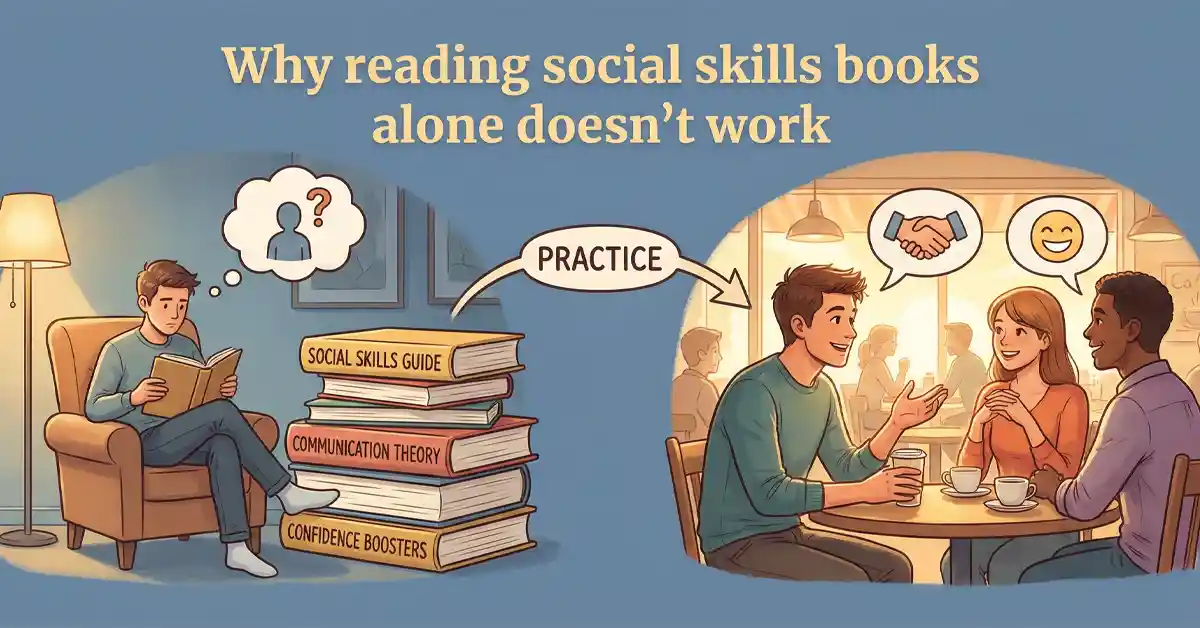
Gaining social confidence requires action, not just information. While books provide excellent strategies and roadmaps, they cannot change your habits or physical reactions for you. Real improvement only happens when you move from reading to practicing in the real world.
What This Topic Means in Simple Words
Many people believe that if they understand a concept intellectually, they have mastered it. This is a common misunderstanding.
Think of learning social skills like learning to ride a bicycle. You can read every manual on physics, balance, and pedaling. You can understand exactly how the gears work. However, the first time you sit on a real bike, you might still fall over.
Reading gives you the “theory.” It puts the information in your head. But social skills involve your body, your voice, and your emotions. Why reading social skills books alone doesn’t work is that it skips the “muscle memory” phase. You need to train your brain to react calmly in the moment, which a book cannot do for you.
Why This Problem Matters
This issue causes a lot of frustration for people trying to improve themselves. You might finish a highly rated book and feel a rush of excitement. You feel prepared. But when you walk into a party or a meeting the next day, you may freeze up just like before.
This often leads to negative self-talk. You might think, “I read the book, so why am I still awkward? There must be something wrong with me.”
There is nothing wrong with you. The problem is the method. Reading is a passive activity. It is safe and comfortable. Interacting with people is an active activity. It is often unpredictable and uncomfortable. When you rely only on reading, you get a false sense of progress. You feel like you are doing the work, but you are actually avoiding the scary part: the practice.
Key Ideas from “How to Talk to Anyone” (Simplified)
The book How to Talk to Anyone offers many specific techniques to improve communication. However, simply knowing the names of these techniques is not enough. You must understand the simple principles behind them to use them effectively.
Here are four core concepts from the book, explained simply:
1. The Delayed Smile Most people smile instantly when they see someone. This can sometimes look automatic or insincere. The book suggests waiting just a second before smiling. Look at the person’s face, pause, and then let a warm smile spread over your face. This makes the smile feel personalized for that specific person.
2. Steady Eye Contact When you are listening to someone, usually you look at them. But when you stop talking or look away, it can break the connection. The idea here is to keep your eyes on the person even slightly after they finish speaking. It makes you appear very interested and confident.
3. Turning Your Whole Body When someone new approaches you, do not just turn your head. Turn your entire body toward them. It acts like a “pivot.” This physical action sends a strong signal that they have your full attention. It makes the other person feel special and welcomed without you saying a word.
4. The “Old Friend” Mindset Anxiety often comes from treating strangers like strangers. The advice is to pretend the person you are meeting is actually an old friend you haven’t seen in a while. This changes your body language. Your eyebrows relax, your posture opens up, and you speak more naturally. It tricks your brain into feeling safe.
More Post: Why Can’t I Talk Confidently to People? (And How to Start)
How This Helps in Real Life
Applying these ideas, rather than just reading them, changes how you move through the world.
- In Daily Conversations: You stop worrying about what to say next. Instead, you focus on how you are looking at the person and how you are standing. This quiets the anxious thoughts in your mind.
- Building Confidence: Confidence comes from evidence. When you try the “Delayed Smile” and see the other person smile back warmly, you get proof that you can handle the situation. This builds real confidence.
- Social Situations: Large gatherings become less draining. When you use the “Old Friend” mindset, you spend less energy protecting yourself. You become more open, which encourages others to approach you.
The goal is not to become a performer. The goal is to remove the barriers that stop your natural personality from shining through.
Who This Is Helpful For
Beginners If you feel nervous starting conversations, moving from reading to doing is the most important step. Small physical changes often work better than memorizing lines.
Introverts Introversion is not a flaw. However, if you want to connect with others without draining your battery, learning to send the right non-verbal signals helps. It allows you to be friendly without talking non-stop.
Professionals In business, people often hire and promote people they like. Understanding how to make others feel important is a career skill. It helps in negotiations, interviews, and networking events.
Common Mistakes People Make
When people try to apply what they read, they often fall into specific traps.
- Trying to do too much at once: You cannot practice eye contact, posture, smiling, and conversation starters all at the same time. You will look stiff and feel overwhelmed.
- Being robotic: If you follow a book’s advice too strictly, you might act unnatural. For example, staring at someone too intensely because a book said “eye contact is good” can be creepy.
- Expecting perfection: You will have awkward moments. This is a normal part of learning. Many people quit after one bad interaction.
- Focusing on “tricks”: Some people try to use these skills to manipulate others. This rarely works long-term. People can sense when you are not being genuine.
More Post: How to Start Talking Confidently as a Beginner
Why Reading Social Skills Books Alone Doesn’t Work Without Practice
To actually improve, you must bridge the gap between the page and the real world. You need a plan to apply what you have learned safely and naturally.
Start with Low-Stakes Practice Do not practice your new skills on your boss or a date. Practice on people you will likely not see again, like a cashier, a barista, or a bus driver.
- Try the “Delayed Smile” when buying coffee.
- Practice “Turning Your Whole Body” when a waiter comes to your table.
Focus on One Skill per Week Pick one concept. For seven days, focus only on that.
- Week 1: Focus only on smiling more slowly.
- Week 2: Focus only on keeping steady eye contact. By doing this, the skill becomes a habit. You won’t have to think about it anymore.
Shift Your Focus Outward The biggest barrier to social skills is self-consciousness. You are worried about how you look. The techniques in books like How to Talk to Anyone work best when you focus on making the other person feel comfortable. When you focus on them, your anxiety usually drops.
Related Questions People Ask
How long does it take to get better at social skills?
It varies for everyone. However, if you practice one small skill every day, you will likely feel more comfortable within a few weeks. It is a gradual process, not an overnight fix.
Can I learn this if I am naturally shy?
Yes. Shyness is a feeling, but social skills are a set of behaviors. You can learn the behaviors even if you still feel shy inside. Often, the feelings of shyness decrease as your skills improve.
Is it fake to use techniques from a book?
It is not fake if your intention is good. If you use these skills to make others feel welcome and heard, it is a kindness. It is like learning table manners; it is a way to show respect to others.
What if I try a technique and it goes wrong?
It happens. You might smile, and they might not smile back. That is okay. Social interactions involve two people. You cannot control the other person. Just shrug it off and try again later.
Final Takeaway
Books are excellent tools, but they are only the starting point. Why reading social skills books alone doesn’t work is simply because communication is a physical and emotional sport, not an academic subject.
Do not be hard on yourself if you have read many books but haven’t seen results yet. Put the book down. Go out into the world. Pick one small thing to change today, and treat every interaction as a chance to practice. Your progress will come from your actions.
Need Any self-help books visit our website - www.boirath.com


1 thought on “Why Reading Social Skills Books Alone Doesn’t Work”