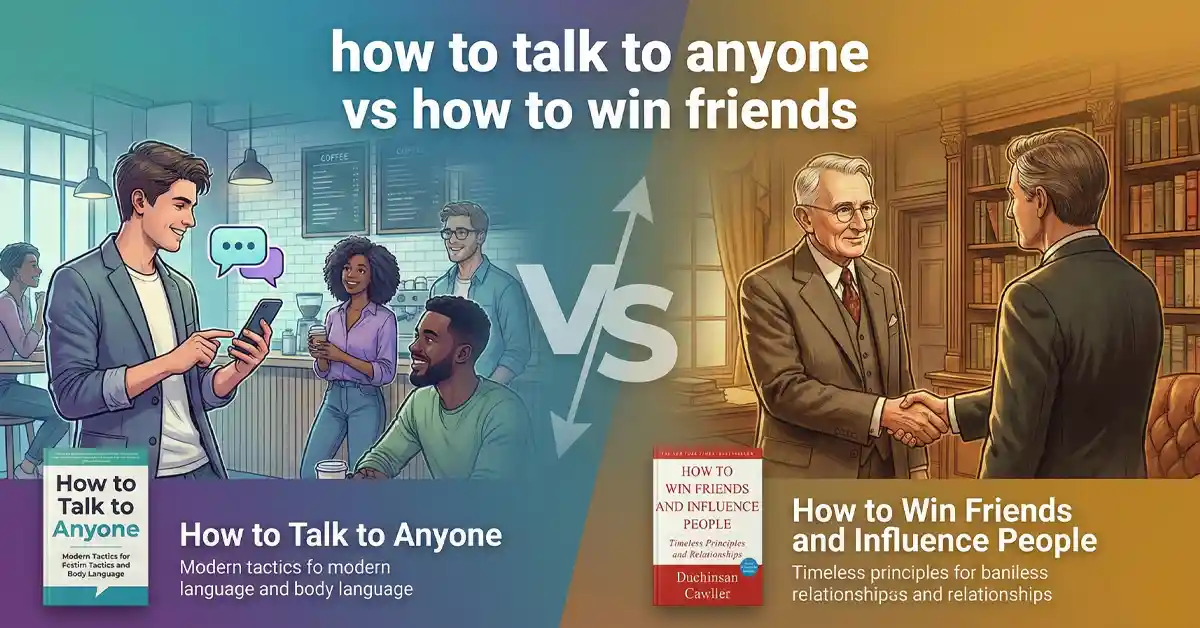
When comparing how to talk to anyone vs how to win friends, the main difference is the focus. How to Talk to Anyone offers specific, actionable tricks for modern conversations. How to Win Friends and Influence People teaches timeless principles for building deep relationships. Both books help you improve your social skills in different ways.
What This Comparison
This comparison looks at two of the most famous books on communication.
One book acts like a mechanic’s manual. How to Talk to Anyone gives you tools. It tells you exactly what to do with your body and voice. It focuses on the “how” of talking.
The other book acts like a philosophy guide. How to Win Friends and Influence People gives you rules for behavior. It tells you how to think about other people. It focuses on the “why” of connecting.
Choosing between them is like choosing between a recipe book and a cooking class. One gives you quick steps. The other teaches you how to be a chef.
Why People Compare These Two
Readers often feel confused because both books promise a similar outcome: better people skills. Each claims to help you communicate more effectively and feel more confident around others.
That’s why comparisons are so common. Many readers want to know where to begin, especially when time is limited. Sometimes there’s only room for one book, and the problem feels urgent—like shyness at parties or communication issues at work.
The real question becomes which book solves your problem faster. No one wants to spend time on advice that doesn’t match their situation. A clear comparison makes it easier to choose the right tool for improving your social life.
Option A: Strengths and Limitations of “How to Talk to Anyone”
This book by Leil Lowndes focuses on 92 specific “little tricks.” It is written for quick application in the modern world.
Strengths
- Very Actionable: It gives you physical things to do. For example, it tells you exactly how long to hold eye contact.
- Covers Modern Situations: It talks about parties, networking events, and phone calls. It feels relevant to today’s life.
- Easy to Skim: You do not have to read it in order. You can pick a chapter that sounds interesting and learn a trick in two minutes.
- Focuses on Body Language: It puts a lot of emphasis on your smile, posture, and eyes. This is great for making a good first impression.
Limitations
- Can Feel Artificial: Some readers feel the tricks are like acting. If you do them wrong, you might look fake.
- Surface Level: It fixes the outside of your communication. It does not always change how you feel on the inside.
- Too Many Rules: Remembering 92 different tricks can be hard. You might feel overwhelmed trying to remember which one to use.
Option B: Strengths and Limitations of “How to Win Friends and Influence People”
This book by Dale Carnegie was written in 1936. It focuses on fundamental human nature and kindness.
Strengths
- Timeless Wisdom: The advice works in any era. Concepts like “don’t criticize” or “remember names” never go out of style.
- Changes Your Mindset: It teaches you to genuinely care about others. This builds real, lasting trust.
- Simple Principles: There are only a few core rules to remember. You do not need to memorize a long list of tricks.
- Great for Leadership: It is excellent for managing people and resolving conflicts without arguments.
Limitations
- Dated Examples: The stories are very old. They talk about historical figures like Lincoln or old business tycoons. Some readers find this boring.
- Lacks Specific “Moves”: It tells you to “be interested,” but it does not always tell you exactly how to stand or what to say to show interest.
- Can Encourage People-Pleasing: Some critics say it teaches you to agree with everyone just to make them like you.
Side-by-Side Comparison: How to Talk to Anyone vs How to Win Friends
Here is how the two books compare in specific areas of learning.
Ease of Use
How to Talk to Anyone is easier to use immediately. You can read a tip like “The Flooding Smile” and try it five minutes later. The instructions are physical and clear.
How to Win Friends requires more thought. You have to change your attitude. It takes time to practice being a good listener or avoiding criticism.
Learning Curve
How to Talk to Anyone has a flat learning curve. You learn one trick at a time. It is like collecting tools in a box. You can stop anytime.
How to Win Friends is a steep curve at first. You must unlearn bad habits. You must stop yourself from arguing or complaining. This takes effort and self-control.
Practical Value
How to Talk to Anyone has high practical value for strangers. It helps you work a room, start a chat, or handle awkward silence. It is great for “short-term” interactions.
How to Win Friends has high practical value for relationships. It helps you keep friends, get promoted, or save a marriage. It is great for “long-term” connections.
Long-term Usefulness
How to Talk to Anyone is useful as a reference. You can check it before a big event. However, you might outgrow the tricks once you become confident.
How to Win Friends often becomes a life philosophy. People read it once a year. The principles become part of your character, not just things you do.
Which Option Is Better for Different People
Choosing the right book depends on who you are and what you need right now.
For Beginners If you are terrified of social situations, start with How to Win Friends and Influence People. It builds a strong foundation. It teaches you that people just want to be heard. This lowers your anxiety.
For Busy Professionals If you need to network next week, read How to Talk to Anyone. You can quickly learn five tips to look confident. It is faster for immediate results in business settings.
For Introverts How to Talk to Anyone is very helpful for introverts. It gives you a script. It tells you what to do with your hands and eyes. This removes the guesswork from socializing.
For Leaders and Managers How to Win Friends is the better choice. It focuses on influencing people and handling mistakes. It teaches you how to lead without making enemies.
Common Mistakes When Choosing
Here are simple errors people make when deciding between these books.
- Looking for a “Magic Pill”: Some people think reading the book is enough. Both books require you to go out and speak to real humans.
- Dismissing the Old Book: Many ignore Dale Carnegie’s book because it is old. They think it won’t apply to the internet age. This is wrong. Human nature has not changed.
- Thinking “Tricks” are Bad: Some refuse to read Leil Lowndes because they think “tricks” are manipulative. However, learning to smile correctly is just a social skill, not a lie.
- Reading Without Practice: It is a mistake to read either book cover-to-cover without stopping. You must pause and try the advice.
How to Choose the Right Option
To make the best choice, look at your current life goals.
Assess Your Timeline Do you need help for a party tonight? Choose How to Talk to Anyone. Do you want to become a better person over the next year? Choose How to Win Friends.
Identify Your Weakness Is your problem that you don’t know what to say? Or is your problem that people don’t seem to like you?
- If you don’t know what to say, you need tactics (Lowndes).
- If people don’t connect with you, you need principles (Carnegie).
Check Your Reading Style Do you like short, snappy chapters? You will prefer Lowndes. Do you like stories and moral lessons? You will prefer Carnegie.
Related Questions People Ask
Yes, absolutely. They work well together. Read How to Win Friends to get the right mindset. Then read How to Talk to Anyone to get the specific tools.
How to Talk to Anyone is generally easier. The language is very modern and casual. Carnegie’s book is easy too, but the language is a bit older.
Leil Lowndes references some studies, but it is mostly pop psychology. It is based on observation rather than strict academic science.
Yes. showing genuine interest in others is the most attractive trait you can have. The principles apply to romance just as well as business.
Final Thought
When looking at how to talk to anyone vs how to win friends, there is no loser. If you want a quick toolkit for modern socializing, pick up How to Talk to Anyone. If you want a deep guide on human nature and relationships, choose How to Win Friends and Influence People.
The best approach is to start with the one that excites you most. Improving your social skills is a journey. Both books are excellent maps to help you get there.
Need those book? visit our website - www.boirath.com