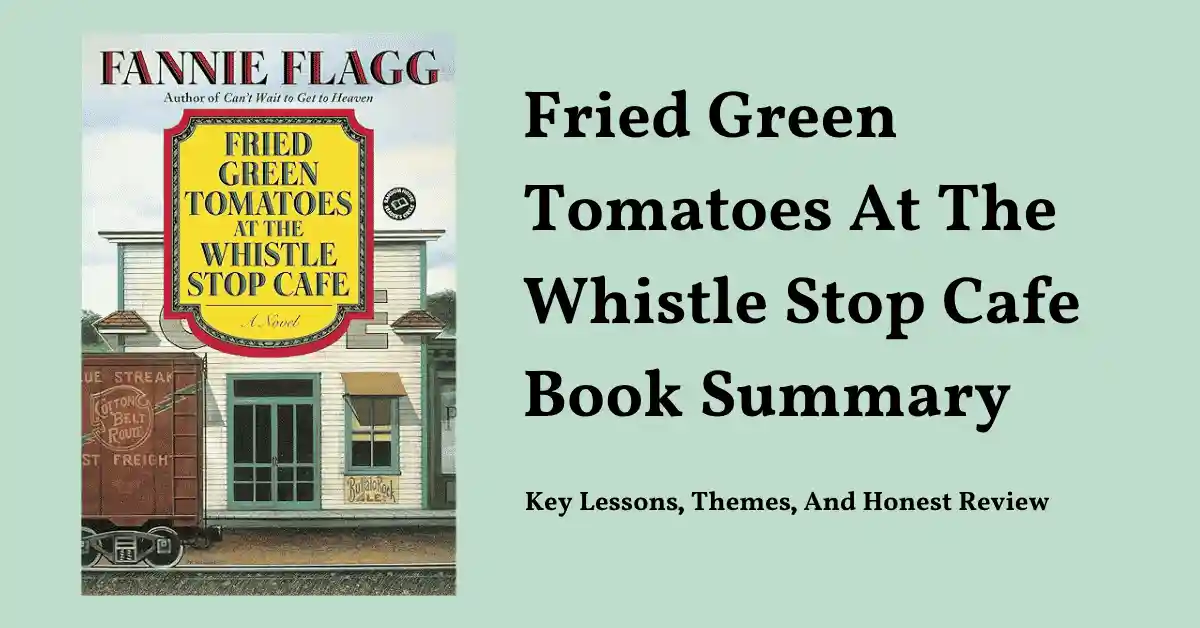
Fried Green Tomatoes at the Whistle Stop Cafe is Fannie Flagg’s 1987 novel about a lonely middle-aged woman who rediscovers her own courage through the stories of a small Alabama town. Set in Alabama, the book weaves together past and present through the growing friendship between Evelyn Couch, a middle-aged housewife, and Ninny Threadgoode, an elderly nursing home resident. Ninny’s memories center on her sister-in-law Idgie Threadgoode and Idgie’s friend Ruth Jamison, who ran the Whistle Stop Cafe together.
The novel is a strong fit for readers who enjoy warm Southern fiction with humor, grief, and complicated women. It is also a rewarding book to discuss, because its themes reach into family, aging, love, race, and courage.
Quick Book Details
| Detail | Information |
|---|---|
| Title | Fried Green Tomatoes at the Whistle Stop Cafe |
| Author | Fannie Flagg |
| Published | August 12, 1987, by Random House |
| Length | 403 pages |
| Genre | Southern fiction, historical fiction, literary fiction |
| Main topic | Friendship, memory, womanhood, race, family, and community |
| Best for | General readers, students, book clubs, fans of Southern fiction |
| Main message | Stories can keep people alive, change lonely lives, and expose hidden truths |
| Reading difficulty | Easy to moderate, with a structure that asks for patience |
| Recommended? | Yes, especially for readers who enjoy warm, layered fiction |
The novel spent 36 weeks on The New York Times Best Seller List. It was adapted into the 1991 feature film Fried Green Tomatoes.
Fannie Flagg was born Patricia Neal in Birmingham, Alabama, on September 21, 1944. She co-wrote the screenplay for the 1991 film adaptation, a script nominated for an Academy Award. The novel drew praise from both Harper Lee and Eudora Welty. Flagg later published Fannie Flagg’s Original Whistle-Stop Cafe Cookbook (1993) and The Wonder Boy of Whistle Stop (2020), which returns to characters from this novel.
What Is Fried Green Tomatoes at the Whistle Stop Cafe About?
The novel is about how one woman’s stories help another woman find herself again. Evelyn Couch is unhappy, insecure, and stuck in middle age. During her weekly visits to a nursing home with her husband, she befriends Ninny Threadgoode, another resident.
Ninny tells Evelyn stories of her youth in Whistle Stop, Alabama, where Idgie and Ruth ran a cafe. The book moves through family history, town voices, cafe life, loss, racism, violence, and deep loyalty. The structure can feel loose at first, but that looseness is also part of its charm.
The novel is useful for students and book clubs because it gives a lot to discuss. It covers friendship, aging, social judgment, racial injustice, food, grief, and the way small towns remember people.
How the Novel’s Dual Narrative Structure Works
The novel is told in both past and present tense, with Ninny narrating the past and Evelyn’s story set in the present. The narration alternates among a fictional newsletter called The Weems Weekly, the Threadgoodes’ house in Birmingham, and omniscient narration, and chapter headings establish the date and source of each chapter.
This structure means there is no simple numbered plot to follow. Instead, the book moves between two strands: Evelyn’s life in 1986 and the Whistle Stop story running through the 1920s and 1930s.
| Narrative strand | Main characters | What it does |
|---|---|---|
| Present day | Evelyn Couch and Ninny Threadgoode | Shows a lonely woman changing as she listens to another woman’s past |
| The past in Whistle Stop | Idgie Threadgoode, Ruth Jamison, Sipsey, Big George | Shows the cafe, the community, and the dangers around them |
Plot Summary: Evelyn and Ninny in the Present Day
The present-day story follows Evelyn Couch, who goes weekly with her husband to visit his mother in a nursing home. During one visit, she meets Ninny Threadgoode, another resident.
Evelyn is unhappy with her body, her marriage, and the direction of her life. Ninny’s stories give her another way to see things, and the friendship becomes the engine of her personal change.
Inspired by Ninny’s stories, Evelyn begins working outside the home selling Mary Kay Cosmetics and becomes happier. Her transformation gives the present-day sections their purpose: the past is not there only for nostalgia, but as a push toward action.
Plot Summary: the Whistle Stop Cafe Story in the Past
Most of the novel’s emotional weight belongs to the Whistle Stop story, which centers on Ruth Jamison and Idgie Threadgoode, two best friends often read as lovers whose lives shaped everyone around them. Whistle Stop itself is a railroad town roughly ten miles outside Birmingham, Alabama.
Idgie Threadgoode is portrayed as an unrepentant tomboy who becomes reclusive after her brother Buddy is killed in a railway accident. The novel’s warmth sits beside real darkness. Ruth marries Frank Bennett, a violent, abusive man who often beats her, and she stays with him until her mother’s death. Afterward, Ruth sends Idgie a message appealing for help, and Idgie, along with several men, rescues Ruth and her son from Bennett.
With money from her father, Idgie establishes the Whistle Stop Cafe, with Sipsey and her daughter-in-law Onzell as cooks. During the Great Depression, the cafe became known to homeless people across the US as a welcoming place to receive a meal. Big George and Sipsey are African American characters closely bound to Idgie’s family.
The story carries grief as well as comfort. When Ruth dies of cancer, Idgie is heartbroken. Several years later, Idgie and Big George are arrested for Frank Bennett’s murder, and the case is dismissed when the local minister, repaying Idgie for helping his son, falsely testifies that they were at a three-day revival when Bennett went missing.
The novel later reveals that Sipsey killed Frank Bennett when he tried to kidnap his and Ruth’s son, and that Big George disposed of the body. These reveals sit alongside the cafe’s daily kindness, which is part of what makes the book feel bigger than a cozy small-town story.
Main Themes and Key Takeaways
Friendship Can Save a Lonely Person
Evelyn is stuck when she meets Ninny. She needs someone who sees her and talks to her without judgment. The novel explores friendship, aging, and family as connected experiences rather than separate ones.
Stories Can Give People Courage
Ninny’s stories do more than entertain Evelyn. They give her examples of brave women, hard choices, and loyal love. By the end, the past has changed what Evelyn believes is possible for her own life.
Chosen Family Matters
The book shows many people caring for each other beyond blood ties. The cafe becomes a home for people who need one, and the novel treats family as something people build as well as inherit.
Small Towns Can Hide Deep Pain
Whistle Stop has warmth, humor, and food. It also has racism, abuse, gossip, and fear. The novel explores the dehumanizing effects of racism on both Black and white people, so the town’s charm and its injustices belong in the same discussion.
Aging Does Not Erase a Person’s Worth
Ninny may live in a nursing home, but her mind holds a full world. Evelyn learns from her because she listens, which makes the novel’s treatment of aging one of its quiet strengths.
Love Can Be Quiet and Fierce
Idgie and Ruth’s relationship carries much of the book’s emotional weight. Their relationship is not explicitly described as lesbian, though the community around them recognizes it. That ambiguity is part of how the novel handles love that society refuses to name clearly.
Food Carries Memory
The cafe’s food is part of the novel’s warmth. Meals bring people together and hold the feeling of home, which is why the cafe scenes work well for book club discussion.
Is It Worth Reading? A Conditional Review
Fried Green Tomatoes at the Whistle Stop Cafe is worth reading if you enjoy character-driven fiction with humor and heart. It is warm, funny, sad, and easy to discuss.
What works well is the voice. Fannie Flagg writes with humor and affection, and the characters feel lived-in. The novel’s themes of family, aging, lesbianism, and racism give it more depth than a simple comfort read, and it earned praise from Harper Lee and Eudora Welty.
What feels weaker is the structure. The book jumps between times, voices, and side stories, and some readers may feel lost at first. The advice here is simple: read slowly and keep track of the main names.
Who Should Read It, and Who Might Not
This novel is a good fit for readers who enjoy warm character stories with serious themes under the humor. It also works well for book clubs because readers can argue about the structure, relationships, and ending. Students may find it useful for studying Southern fiction, women’s lives, memory, race, and adaptation.
- Readers interested in Southern fiction
- People who enjoy stories about female friendship
- Book clubs looking for emotional discussion
- Students studying American fiction
- Fans of Fannie Flagg, Harper Lee, or small-town stories
- Readers who liked the movie and want more detail
If you enjoy Southern fiction built around women and community memory, The Book Woman Of Troublesome Creek Summary covers a different Appalachian story with a similarly strong sense of place.
Some readers may not enjoy the shifting structure. The book moves through memory, newspaper notes, and many side characters. Others may want a faster plot, since the novel spends a lot of time building mood, voice, and town history.
You may not like it if you prefer straight plot order, short casts of characters, fast action, clear chapter titles, or stories with no loose ends. Readers who want a break from fiction entirely may find The Little Book Of Common Sense Investing John Bogle Summary more useful.
How It Compares with Similar Books
| Book | Best for | Main difference |
|---|---|---|
| Fried Green Tomatoes at the Whistle Stop Cafe | Fans of warm Southern fiction | Uses memory, humor, and town voices to tell a layered story |
| To Kill a Mockingbird | Readers studying race and justice | More court-centered and told through a child’s view |
| The Secret Life of Bees | Readers who enjoy found family stories | More coming-of-age focused and spiritual in tone |
Choose Fried Green Tomatoes at the Whistle Stop Cafe if you want a warm town story with serious social themes and a large cast across two eras. Choose To Kill a Mockingbird if you want a stronger legal and moral conflict. Choose The Secret Life of Bees if you want a more direct coming-of-age story.
Common Reader Expectations and Pitfalls
Some readers expect the book to follow the film exactly. The novel has more voices, more side stories, and a looser structure than a film can carry. Another common mistake is reading it only as a cozy Southern story. The book has charm, but it also deals with abuse, racism, loss, and fear.
- Reading too fast through the time shifts
- Mixing up Threadgoode family members
- Skipping the newspaper sections
- Treating the cafe as only a cute setting
- Missing Evelyn’s growth in the present
How to Apply the Lessons from the Book
- Listen to older people’s stories. Ask real questions and give them time to answer.
- Notice who makes you braver. Spend more time with people who help you act with courage.
- Build small places of care. A meal, a visit, or a kind word can matter more than it seems.
- Look at the full town, not only the warm parts. Notice who has safety and who does not.
- Write down family memories. Small stories disappear if no one saves them.
Frequently Asked Questions
What Is Fried Green Tomatoes at the Whistle Stop Cafe About?
Fried Green Tomatoes at the Whistle Stop Cafe is about Evelyn Couch, a lonely middle-aged woman, and Ninny Threadgoode, an older woman who tells her stories about Whistle Stop, Alabama. The novel centers on Idgie, Ruth, the cafe, and the lives shaped by friendship, memory, love, and injustice.
Is Fried Green Tomatoes at the Whistle Stop Cafe Worth Reading?
Yes, it is worth reading if you enjoy character-driven fiction with humor and heart. It may feel slow if you prefer a straight plot, but the characters and themes make it a strong book club choice.
What Are the Main Lessons from Fried Green Tomatoes at the Whistle Stop Cafe?
The main lessons are that friendship can change a life, stories keep people connected, and courage can grow through example. The novel’s themes of family, aging, lesbianism, and racism also ask readers to see the town’s comfort and its unfairness together.
Is Fried Green Tomatoes at the Whistle Stop Cafe Better Than the Movie?
The book gives you more characters, more town history, and more detail, while the film offers a tighter story. Fannie Flagg co-wrote the screenplay, and the adaptation was released in 1991.
Why Do Some Readers Dislike Fried Green Tomatoes at the Whistle Stop Cafe?
Some readers dislike the time jumps and large cast. Others want a faster plot or clearer chapter flow. The novel asks for patience because it moves through memory and town voices.
How Should I Read Fried Green Tomatoes at the Whistle Stop Cafe?
Read it slowly and track the main names. Pay attention to the dates and newspaper-style sections, and notice how Evelyn changes after hearing Ninny’s stories.
Conclusion
This summary of Fried Green Tomatoes at the Whistle Stop Cafe comes down to memory, friendship, and courage. The novel is warm, but it has real pain under the humor.
The book works best for readers who enjoy character and voice more than plot speed. Idgie, Ruth, Ninny, and Evelyn stay with readers because they feel human. The main limitation is the structure, which can feel scattered, especially early on. Read the full novel if you want the complete Whistle Stop experience, because its charm lives in the voices, small scenes, and slow build of affection.